
For anyone that follows my reddit history or knows me at my game store, I'm what you could lovingly refer to as a "rules lawyer". As such, I was probably more excited for this Spirit of Rebellion rules update than I was for the actual Spirit of Rebellion set to come out. In this post, I'm going to run through the rules reference updates and cover the new good, bad and confusing rulings and try to give contest to each update and how it will effect the game.
Errata
FFG has introduced errata to the game with this new rules update and it is a particularly bold action for them to take. Most game companies use errata to address an issue that has already reared it's ugly head and affected the game, but FFG took a more proactive approach changing things before they've become an issue. I won't go into much detail on this since FFG covered them fairly thoroughly in their Rules Update Announcement Article
Hyperspace Jump - Text now reads "End the action phase. You may switch the battlefield with the battlefield that is not being used. Set this card aside instead of discarding it."
This basically is to neuter the Hyperloop combo where you could use the Emperor's Throne Room and Millennium Falcon to repeatedly end the round at will. Planetary Uprising in Spirit of Rebellion created a lot of fear that this would just become too powerful. While it never proved to be particularly good or consistent in Awakenings, it was always a negative play experience for anybody sitting across from it, so in that respect this errata is good.
If it was me though, I think I would have changed Millennium Falcon's text to put the card it plays from the discard pile in the set aside zone. They said they were apprehensive to change a legendary vs. an uncommon in the article, but I don't like that logic here. Millennium Falcon's text is the real problem here and it's most likely only a matter of time until there is another abusive event you can use with it.
Outer Rim Smuggler - Text now reads "The first time each round you play the last card from your hand, gain 1 resource"
ite resources with a loop with two Outer Rim Smugglers and two copies of Return of the Jedi"
This errata I'm less of a fan of - I get that the particular loop was a problem, but the poor Outer Rim Smuggler lost a lot of power from more standard interactions before it was even determined if the loop would be an issue. Here is a case where I would have rather they did what they did to Hyperspace Loop and have Return of the Jedi put itself in the set aside zone after resolving.
In a non-infinite loop world, Outer Rim Smuggler seemed to have fun interactions with card draw cards and Cheat, now he's probably relegated to the junk character pile.
Rules Updates
"Set-Aside Zone"
Formerly just the "Set-Aside Dice" area, now becomes a fully-fledged zone anything can go in - basically it's a "removed from game" zone, if you're familiar with other games' verbiage. This is a solid rule addition - games generally need some kind of zone like this to balance certain cards.

"Blanks and Specials Value"
Blanks and Specials are now defined to have a value of 0 that cannot be increased or decreased. This rule primarily has to do with C-3PO in Spirit of Rebellion. C-3PO's text reads:
"Action - Remove this die to resolve one of your dice as if it were showing a different symbol (it keeps its original value)."
So everybody was wondering what happens if I resolve a 3 Melee damage side as a 3 Special side with C-3PO's text? Well, don't worry about it, special sides are always 0. Boom. Good rule here
"Extra Actions"
 This one is kind of a doozy and will definitely be something you need to know for the upcoming Rey meta.
"Each action, and any abilities its resolution triggers, must fully resolve before an additional action is taken. Actions wait to be resolved in the order they were created in. They do not enter the queue (see page 17) like other game effects"Before you would resolve the additional action as part of the ability that granted it's resolution. So
for example, if you triggered Rey's After ability with an upgrade on her you would resolve the extra action when her ability resolved from the queue. This is no longer the case.
Think of extra actions you earn now as being part of their own tally - and that you can only resolve additional actions when the queue is empty.
So per the example in the rules reference - you play a Holdout Blaster on Rey.
The Holdout Blaster resolves and you get an extra action, but Rey's After ability gets triggered and added to the queue. You have to resolve any abilities an action triggers before you can take an additional turn so you have to resolve Rey's after ability which gives you another additional action.
Now you have two additional actions and an empty queue, you can use one of them. Per the example you use it to activate Rey and your opponent has Jango.
Jango triggers off the action used to activate Rey, so his ability is in the queue - you can't take your second Rey action until the queue is empty. So Jango's ability will resolve and the opponent will choose to activate him or not.
Then you now have 1 additional action left - you can now use that.
This is a departure from the previous rule set where the Rey player would have gotten to take both of their additional actions before the Jango player would get their option. It seems like a simple change, but there are a lot of implications:
- The Jango player has to make the decision to activate with less information since it happens between additional Rey actions
- The Rey player could get affected by any triggers from Jango activating before Rey gets to take her second additional action. (looking at you new 0 cost supports)
I think this change is ok, but everybody has to relearn new interactions that they thought they had down. Another concern I get is FFG's tendency to lean away from wanting to use their queue to help regulate timing actions. Maybe it's my experience with other games that had set timing chains that every game action used, but I like having something concrete. I don't like having all kinds of different timing chains to keep track of.
"Passing"
 FFG backed off their super confusing "game state" rule from their previous update, which is definitely for the better. The new rule for an action to be considered passing is:
"If a player takes an action that does nothing, then they are considered to have passed their turn instead."
It's a lot more black and white than the vague game state definition previously. It seems an action truly has to do nothing at all to be considered a pass, such as the example they provided of using Veers ability with no Veers die in the pool.
As a consequence of this, activating an empty Backup Muscle is now a perfectly valid action and does not count as a pass. So confusing that they are walking back from the highlight example from the last update, but at least things are clearer now.
"No more damage types from damage dealt by cards"
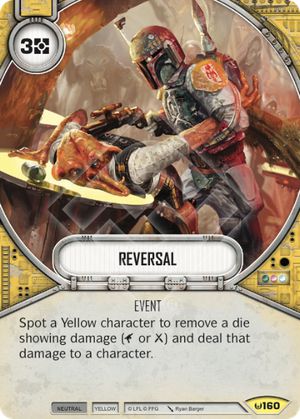 This is a weird rule update that came out of nowhere. There weren't a lot of implications, but generally it was believed that damage from Reversal and Deflect for example, matched the damage type of the die that was removed. New rule:
• Unless specified, damage is neither ranged or melee. “That damage” is short for “that amount of damage.”
This basically means unless an event very specifically says "deal 2 melee damage to a character" it's damage is not typed. And I think right now that means that no events that exist in the game deal typed damage. Deflect not being ranged damage was specifically used by them as an example.
"Damage distribution"
"When a player distributes damage “as they wish,” players cannot deal excess damage (damage above their health) to their characters. "Fairly straight forward and ok rule clarification - helps things like F-11D rifle.
"Rolling and reroll"
When a card refers to rolling a die, this applies to both rolling it into your pool and rerolling it (if it was already in your pool)Also straight forward and a good clarification - there were a lot of questions on this in regards to the new 0 cost supports
"Replacement Effects aka the Second Chance rule"
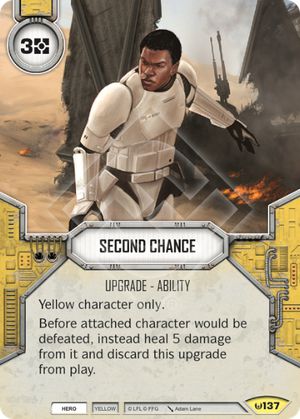 Last but certainly not least - this rule is the one I feel is in crazy pants territory.
So last update they made the distinction that effects that use "instead" are replacement effects - "instead" is a little bit of a weird word to key off of, but it was ok to roll with.
Now they've added a subset of words to look out for - "would be" - read this rule entry:
"Some replacement effects that are part of before abilities use the word “would be” in their text. These effects are faster than other before abilities, and no abilities can be triggered off of the original effect."Ok so now we have a before effect hierarchy where some before effects are "faster than other before abilities". That's silly, but OK
Then it goes on to say "no abilities can be triggered off of the original effect." then they go on to give this specific example:
"Example: Second Chance (r137) resolves before the before ability on General Grievous (r3). Since the character affected by Second Chance is no longer defeated, General Grievous’ ability cannot be triggered."They don't really flesh out what "faster than other before abilities" means, but the problem with the example is that they say "General Grievous' ability cannot be triggered", but the problem is at this point General Grievous' ability was already triggered.
It's obvious their intent is they don't want Grievous' ability to work on a Second Chanced character, but their own rules are still working against them and this is murky as crap.
 Second Chance and Grievous are both simultaneous triggers - they meet their trigger condition at the same time. Here is the section from the current rules reference on Simultaneous abilities:
"When two or more triggered abilities meet their trigger conditions at the same time, the player who is resolving those abilities chooses the order they resolve in (in the case of before abilities) or enter the queue in (in the case of after abilities). If more than one player has abilities that are simultaneous, the player who controls the battlefield chooses the order they resolve/enter the queue in"Notice it doesn't say the player picks the order the abilities are triggered in, it says the player picks resolve in.
the order they
Clearly the intent of the "would be" rule is that these types of replacement modifiers trigger and resolve before any other effects are allowed to trigger, but they word that so poorly.
And with all of the specific tinkering just for this, they might as well just call it the "Second Chance" rule.
Things They Missed
"Moving an upgrade"
I wish they would have fleshed out the moving section to include what happens when you move upgrades around. We already have the fairly confusing scenario in Awakenings with Grievous and what happens to a dice in the pool when you move an upgrade from one player's character to another. Now we have all kinds of moving shenanigans with Cargo Hold and they still didn't add a update, clarification, FAQ anything about what happens to dice in a pool when something moves.

As far as we know, dice stay in the pool when something is moved, since it doesn't tell us to remove it. Redeploy specifically says to put the die back on the card so that is different.
Now we also have a scenario where moving training of a character causes them to become non-elite again. We know they lose the die and we assume the owner gets to decide which die gets set-aside, but again no clarifaction, FAQ, etc.
 "Can Obi-wan be repeatedly defeated?"

Obi-wan's text from SoR reads:
Before this character is defeated, you may play a Blue card from your hand or discard pile for free.So what happens if I use his ability to play Noble Sacrifice targeting Obi-wan. Do I get to use his
ability again and play Noble Sacrifice repeatedly? It needs a clarification, but at this point I'm ruling you're allowed to do this and exhaust your whole opponent's team THEN play a free One With The Force if you want. It might not be intended, but they didn't clarify that a character can't be defeated more than once.
Also as a side note - the Second Chance rule kills the Obi-wan with Second Chance getting to play a free card and living play.
"Jango the puppet master"
The current Simultaneous Ability rule reads:
When two or more triggered abilities meet their trigger conditions at the same time, the player who is resolving those abilities chooses the order they resolve in (in the case of before abilities) or enter the queue in (in the case of after abilities). If more than one player has abilities that are simultaneous, the player who controls the battlefield chooses the order they resolve/enter the queue in.
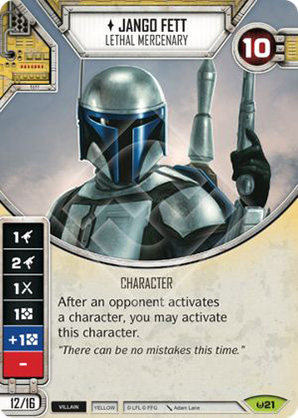 What's the problem, right? Let's put it this way, you got Fast Hands and Blackmail on Jabba and your opponent has Jango and controls the battlefield. It doesn't matter if that Jango is already exhausted,
 just the simple fact that your opponent has him on the field means he gets free reign to always determine the order you have to resolve Jabba's ability, Fast Hand's ability and Blackmail's ability.
So usually that means he's going make you resolve Fast Hands first if your dice suck. Blackmail first so he can remove it. Jabba's reroll will always be last.
And that's just one situation - is it fair that a Jango player with the battlefield should ALWAYS get to dictate the order of every action that triggers off of an opponent activating a character?
It seems a bit over powered when you think about it and will probably only get worse with more options in later sets.
The "fix" could be to change it so that the battlefield controller gets to choose which PLAYER gets to resolve their abilities first when they are simultaneous. That way players can still chain their own abilities ideally for them, the battlefield player just gets the advantage of choosing who goes first.


No comments:
Post a Comment